by ©Natalija Aleksandrova
(Updated, presented at the 10th International EAHAE Conference, Poland, 2014)
Most horse owners are aware of the damage and crisis inherent with fever states. Few horse owners realize how well adapted horses are to deal with cold when certain aspects of their lifestyle are in place for them.
In order for a mammal to survive, internal body temperature is kept within a very narrow range. If the temperature exceeds these limits either above or below, the chemical reactions in the body function improperly, or they stop functioning at all. Fluctuations outside of the normal temperature range result in health problems or death of the animal.
Mature horses maintain their internal body temperature at a range of around 38℃. Foals, rapidly growing youngsters, pregnant and lactating mares have a higher than normal internal body temperature (Hines, 2004).
Heat in the horse's body is continuously generated as a by-product of metabolism, and a healthy animal has significant internal sources of heat from the metabolic processes (Bicego at al., 2007). To control internal heat loss during the cold time of year, the horse is provided by Nature with complicated and extremely efficient anatomical, physiological and behavioral thermoregulatory mechanisms.

On a genetic level, the domestic horse is the same as its wild counterpart of ancient and of modern times: it has the same abilities and needs to survive and thrive. In order for their amazing natural thermoregulatory mechanisms to be used in the most efficient way, or at all, the domestic horse requires nothing more from the human than only to provide living conditions which respect their natural needs — species appropriate living conditions. These are
conditions which fulfill all the essential biological needs of the horse and allow it to exhibit its natural behaviors which have evolved over several thousands of years:
· herd life/social life (the horse is a herd animal; its brain has different capabilities which the brain of solitary animal does not have; only in a horse living in a herd, its cerebral cortex works properly, giving normal correct orders for functioning of other subordinated brain centers, only such horse is sound and psychologically balanced);
· freedom of movement 24 hours a day (movement is horse's metabolism; hoof health depends on movement);
· free access to forage 24 hours a day, grazing and/or hay (the horse stomach secretes stomach acid non-stop throughout day and night; it needs to be buffered constantly not to develop ulcers)
· free access to shelter, either built or naturally occurred, which first could serve as wind breaker;
· optimal hoof care, either natural or physiologically correct trimming.
We will see how the thermoregulatory mechanisms work in the horse, and how it can be interfered with and damaged through unnatural care and keeping practices when the animal becomes a subject for anthropomorphism. And very importantly, we will see how the horse doesn't always need to grow very long winter hair to feel comfortable during cold times.
Long thick coat is just one of the thermoregulatory mechanisms of the horse, but NOT the only one.
Due to some thermoregulatory factors such as the skin and coat being very good insulators which prevent heat loss and the muscles producing heat through their movements, it is far easier for horses to warm up in cold weather than to cool down in hot weather or after intensive exercising.
Cooling down is more difficult for the horse. Horses are adapted to handle cold.
 Domestic horses taking bath on a spring day after snow just has melted, helping this way their winter coat to shed.
Skin
The horse's skin is responsible both for protecting the interior of the body from outside temperature changes, as well as for not allowing heat loss in cold weather. The skin is also responsible for dissipation of internal heat generated by muscle action in order to prevent the body from over-heating. The skins' thermoregulatory mechanisms consist of four major factors: skin itself, coat, arteries and sweat glands.
1. The skin itself works as an insulating layer through its relative thickness.
2. The coat.
The coat insulation depends on the depth and thickness of the hair layer, the wind speed and the temperature and humidity gradients within the coat (Ousey et al., 1992).
The horses coat changes twice a year through the mechanism called photoperiodism, adapting to different seasonal base temperatures. Sensors in the horse's skin react to the daytime light length changes. The horse is ready to grow their winter coat right after the summer solstice, when days start becoming shorter. The horse is ready to change their winter coat to a summer one right after the winter solstice, when days start becoming longer.
In addition to photoperiod, environmental temperature also affects hair growth. Colder climates produce thicker and longer coats than warmer climates do, when comparing horses who have the same body score and are fed the same amount of food.
Fetuses and newborn foals are provided with the mechanism which controls their coat growth as well. We can see that foals born in early spring are born with a longer coat than those born at the end of spring or in summer.

In addition to growing its coat, the horse can increase the insulation of the coat through the mechanism called piloerection — the raising, lowering or turning in different directions of each individual hair in the coat via hair erector muscles. In this way the horse increases or decreases the thickness of the insulation layer and efficiently varies the amount of airflow to the skin surface. Piloerection increases coat depth 10% to 30% in mature horses (Young & Coote, 1973).
<
 Coat in an arabian breed horse on a very cold winter day (around –27˚C/–17˚F), Central Europe. The piloerection mechanism in use — the hair is raised to increase coat insulation.
The hair erector muscles must be exercised regularly in order to work properly, as with any other muscle in the body.
Hairs of the coat are covered with a greasy substance which creates a water-repelling effect that helps prevent moisture from reaching the horses skin on rainy or snowy days. Water runs down the outer hair while the deeper coat remains dry. Also body heat released via the skin helps to keep it dry inside.

Through regular coat brushing and shampooing, the greasy substance gets removed and the water-repelling effect becomes impaired.
It is not advisable either to clean off the layer of dirt that a horse gets from rolling in mud. Besides being protection against insects, the mud has a cooling effect in warmer weather.

Needless to say, that the popular practice of clipping the hair of a horse's coat completely eliminates the thermoregulatory factor of the coat.
3. Arteries in the skin.
Arteries through muscle actions, called vasoconstriction or vasodilation, can be narrowed or enlarged, regulating blood flow to the skin.
Constricting prevents internal heat loss by reducing the amount of warm blood brought to the cooler body surface. Dilation allows for a larger amount of hot blood from over-heated interiors to reach the body surface and to be cooled. The cooled blood lowers internal body temperature when it's returned back to the interior of the body.
4. Sweat glands.
When the outside temperature is too high for the air to cool the blood through the skin, the sweat glands secrete fluid. Evaporation of this fluid cools the skins surface as well as blood in the surface arteries. In this way, the internal temperature can still be lowered even when it’s hot outside.
The horse may also use sweat glands in extremely cold weather when internal body temperature is too high from exercising.
The horse stops secreting sweat as soon as the internal body temperature has reached its normal range. It then must dry quickly to avoid over-cooling. For this a sweaty horse turns its coat hairs in various directions. If given freedom, it usually seeks a windy spot to quickly, safely and effectively dry itself, contrary to human belief that a horse will catch a cold if stays wet in the wind.
Mentioning the sweat glands mechanism is important because sweat glands are also brought into function through muscle action.
When the body is hot, but not enough to secret the sweat, the horse may use rolling in snow.

Now let's look into other thermoregulatory mechanisms available to the horse.
Lungs
In addition to the skin, the coat, changes in blood circulation and sweating as means of controlling internal temperature, the horse has access to a cooling mechanism involving the lungs. Air exhaled from the lungs contains moisture. In warm conditions, if the above thermo-regulatory mechanisms are not adequate to cool the body, the horse can increase the breathing so that more air is taken in to the lungs and more (warm) water vapor is expelled – taking heat from the body. Most of us are familiar with dogs panting to cool themselves.
Increased breathing can be an effective way to cool the body but unfortunately many horses already breathe more air than is good for them. This is because factors such as stabling, isolation, unnatural eating habits, blanketing, clipping, shoeing etc., impose stress on the physiology which involves increased adrenaline production which is linked to an increase in the volume of air breathed. Over breathing has a direct and damaging effect on the physiology (including for example reduced oxygen availability), and at some point, the physiology may be unable to function adequately and then symptoms arise (http://www.equinebreathing.com).
Over breathing in a cold time may cause excessive loss of internal heat.
Body fat
The amount of fat in the body is another important factor of thermoregulation. In addition to being the body's energy reserve, fat is 3 times more insulating than other tissues due to its low thermal conductivity and poor blood supply (Guyton, 1991; Davenport, 1992). Thus it is important for a horse to have a good layer of fat before winter.
Wild horses and naturally kept domestic horses maintain the natural rhythm of weight change throughout the year with their weight growing up to 20% by Autumn.

Usually we can see that domestic horses with a thicker fat layer in their bodies grow a comparatively shorter winter coat than horses with less fat, when comparing the same breed and size animals. We often see an excessively long hair coat in ill or old animals who have trouble to keep weight due to pain, teeth problems, etc.; or in neglected underfed animals.
Also fat gets distributed more evenly over the body surface in cold conditions instead of being concentrated in some particular areas as it does in hot conditions.
In general, this is one of the cases where a horse seemingly 'doesn't grow enough coat' — it is a horse with a higher body score, who compensates for a longer coat with the body fat.
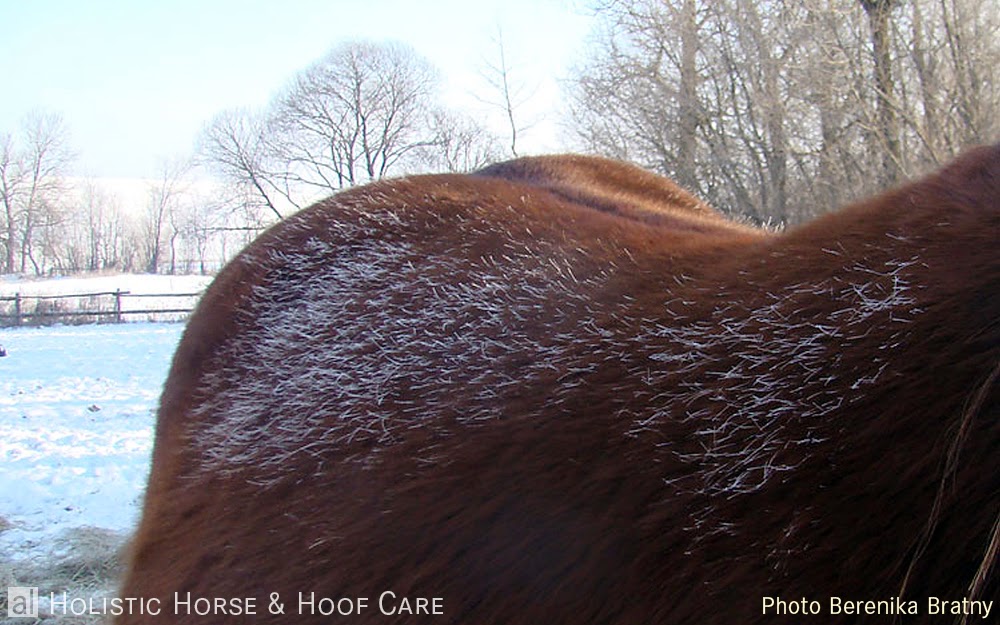
 The horse with a thicker fat layer — we can see the excess heat escaped the body and is visible as the frost on the coat.
Size/shape of the body
Kept in the same conditions, smaller horse breeds have a longer/thicker coat compared to larger breeds. Also we typically see a thicker coat in foals. This is connected to a great effect of allometry on heat balance within animal species. (Allometry — the systematic change in body proportions with increasing body size.) Changes within species occur as animals grow and develop but exist also between breeds of species (Reiss, 1991; Langlois, 1994).
Generally, large body size is an advantage with respect to thermoregulation in the cold. Since, the ratio of heat-dissipating surface area to heat-producing/retaining body mass decreases with increasing body size (Phillips & Heath, 1995; Bligh, 1998). Therefore, large size horses have less relative surface area available for heat exchange, and thus importantly lose less heat in the cold than small size horses do. Small horses lose more body heat than large horses do.
In addition to large body size, a spherical body shape reduces the surface area to body mass ratio (Langlois, 1994). To compensate for the bigger surface/mass ratio northern-type horses, native breeds and ponies generally have evolved heavier rounder bodies with shorter limbs and extremities which are well protected by thick hair, mane and fetlock. Therefore they are more able to retain more body heat and cope with the cold.
Another possible reason your horse 'doesn't grow enough coat' — she is an 18 hand warmblood.
Digesting fiber
Increasing feed intake increases heat production in the horse's body. This is connected to the fact that the process of digesting long fibers produces heat as a by-product.
In cold weather we can observe an increase of food intake in horses. Such extra demand for feed is called climatic energy demand (MacCormak & Bruce, 1991). Horses have been observed to need up to 2.5% more energy for maintenance per 1 degree Celsius drop in outside temperature below their lower critical temperature (Young Coote, 1973; McBride et al., 1985; Cymbaluk et al., 1989a; Cymbaluk, 1990). (Lower critical temperature is individual for every horse/group of horses at different times of year and depends on many other thermoregulatory and environmental factors.)
Importantly, smaller-sized horses have greater low critical temperature values. Thus small-sized horses actually need proportionally more additional feed per kg of the body weight, than bigger-sized horses.
With this thermoregulatory factor, the need of the horse to have free access to food 24 hours per day throughout a year becomes especially important. In colder weather it gives it a chance of increasing heat production through continuously consuming and digesting long fiber. Especially when some of the other thermoregulatory mechanisms aren't yet adjusted in suddenly changing weather conditions such as a rapid drop of temperature.
And here it is important to note that all kinds of slow feeders or feeders preventing a horse from having mouthful of hay whenever it wishes, are not quite natural for the horse. This way of feeding cannot be really considered as fulfilling the horse's need for free access to food as it is in the wild.
 Wild mustangs in Twin Peaks HMA, California, USA. Spring in the range grasslands — lush green grass is mixed with last year dry grasses.
 Przewalski horse in Mongolian steppe, summer.
Dry winter grass still can be quite high in sugars and other nutrients, it is not the same as straw.
 A domestic horse refreshing his menu with old dry grass in winter.
Reducing activity in cold
Feral horses have been reported to reduce locomotor activity in winter compared to summer (Duncan, 1980; Berger et al., 1999; Arnold et al., 2006). Reduced activity in winter is an annual pattern related to decreased outside temperature and thus to a reduction in internal heat production and spending energy (Arnold et al., 2006). This adaptation mechanism of reducing activity helps horses to cope with the energetic challenge of winter.
We can observe similar reduction of activity in winter in domestic horses kept in species appropriate living conditions. Even though the domestic horses usually aren't challenged with a necessity to search for food in winter, this slowing down in their activity obviously has the same purpose as in the wild horses — the reduction of energy wasting in the cold. Thus, it is a normal seasonal rhythm in the horse to exercise less in winter, therefore it is not advisable to forcefully exercise horses in winter.
Short-term activity in cold
Along with general reduction of activity in the cold, we also can observe short sessions of restlessness and locomotor activity during sudden acute cold periods and adverse weather. Short term beneficial movement is a useful bridge until other factors of their thermoregulatory system adjust to the new temperature conditions.
 Reducing heat loss and gaining body heat via body radiation
Sometimes we can observe horses standing or lying down very close to each other. This way they reduce heat loss via radiation. By such positional closeness to each other they reduce the body surface area exposed to the external environment (Bligh, 1998). At the same time, animals who for some reason don't produce enough individual internal heat can use a paddock mate's body-heat radiation via positional closeness as an extra source of heat.
 'Sun-bathing'
Also by changing body posture and orientation, horses can increase absorbed solar radiation as another additional source of heat.
Often we can observe that horses prefer to sunbath under the direct sun instead of eating on short sunny winter days, and as soon as the sun sets they are back to eating. This way they accumulate the sun's energy. This helps them to stay warm without using own body energy.
 'Sun-bathing' on a winer day.
Body position/posture
On windy, rainy, snowstorm days, we can see horses standing with their tails to the wind and their heads low. This way they effectively keep their necks, heads, ears and eyes, underbelly and sheaths out of water and wind. Their tails serve to protect their rear ends — the shorter hairs on the dock fan out deflecting both snow and wind.


Also on such days, horses can be seen standing by the walls outside shelters, or using natural windbreaks such as trees or hills to protect themselves from the elements. And sometimes using each other's body as windbreaker.
 The filly uses the body of the older mare as a wind breaker.
When allowed free choice, it's been observed that horses utilize enclosed spaces, such as shelters or forests, mostly to hide from summer heat and flies.
Snow on backs
Snow which we can sometimes see lying along horses backs during winter also plays the helpful role of providing an extra protective layer against internal heat loss. The snow melted underneath and frozen on top, creates an extra protective layer in a snow storm.

Shivering
Under extreme circumstances, heat in the horse body can be generated by shivering. During shivering, heat is rapidly produced by breaking down ATP* in the muscles (Langlois, 1994). Shivering is usually an acute response to sudden cold exposure. Or sometimes it occurs during extended periods of exposure to cold in rainy weather. In healthy animals, shivering is replaced by normal internal heat production as they adapt to new weather conditions.
(*Adenosine triphosphate — transports chemical energy within cells for metabolism)
Thermoregulation in the hooves
A constant temperature in the hooves is needed for proper metabolism to take place, which with the help of a few other factors, allows for normal horn production. The hard hoof capsule itself has insulating properties. Through hoof mechanism — the expansion and specific deformation of the hoof capsule and inner structures on impact — the impact energy created which deforms the hard hoof capsule and its inner structures, releases heat as a by-product thus keeping the hoof warm. For hoof mechanism to function properly, a horse needs unrestricted hooves, as well as unrestricted movement throughout the day and night. Affixed metal shoes impair the hooves ability to keep this constant temperature inside the hoof capsule by blocking the ability to expand and deform properly on impact. The nails also conduct cold deep inside the hoof capsule. We can often observe how snow builds and balls up on the soles of shoed horses, where as normally (on healthy uninhibited hooves) it would melt.
Effects of blanketing
Blanketing a horse causes a complete mess of the thermoregulation system. A horse cannot increase heat in selected areas of the body. So when trying to warm up parts of the body left exposed to the cold such as the head, neck, belly and legs, the horse in the process becomes over-heated in the parts covered by the blanket. The whole body cools or the whole body heats up. Sweating under a blanket is more of a problem metabolically to the horse than people realize.
What happens if a hot sweaty horse is placed in a stable?
Due to a lack of air circulating in enclosed spaces, cooling takes longer and the horse sweats for longer. The air surrounding the horse becomes saturated and therefore drying also takes longer than normal, because the humid air cannot absorb any more moisture. As a result, the horse remains undercooled, setting the stage for internal disorders: colic, diseases and infections by negatively affecting metabolism's safe temperature margins.
What happens if a horse is continually kept in stables and/or blanketed
Kept in stables or/and blanketed, horses lack stimuli (such as temperature fluctuations [flak…]) triggering the activity of thermoregulatory mechanisms. They don't need to exercise hair erector muscles, nor to dilate or constrict arteries, nor to activate the sweat glands, nor to prepare or deplete healthy fat reserves. All muscles atrophy without exercising after a period of time.
If an animal in this state is suddenly exposed to the cold, they will not be able to activate necessary thermoregulatory mechanisms. As a result the internal body temperature could drop too low which would lead to disruptions in metabolic processes. This can affect, for example, the production and migration rate of white blood cells and antibodies, with partial disabling of them. The result is a stressed animal with a disease or infection hosting internal environment. "The germ is nothing, the terrain is all". Consequentially germs or viruses in the body are allowed the perfect opportunity to over breed.
Stress effect
Besides the fact that the natural thermoregulatory mechanisms can only be fully utilized when a horse is kept in their species-appropriate living conditions, there is an anxiety and stress factor that horses inevitably experience when cut off from their basic needs and are kept in ways unnatural for this species (stabling, separating from equine companions, forced exercising, lack of continuous fiber intake, etc.). The stress also makes them less capable of coping with colds. We know it from human medicine that stress weakens the immune system.
Strengthen your horse immune system giving her the life she was designed for by Nature!
 This writing was inspired by researches of and dedicated to one of my most important teachers — Doctor Hiltrud Strasser.
_____________
References
Arnold, W., Ruf, T., & Kuntz, R. (2006). Seasonal adjustment of energy budget in a large wild mammal, the Przewalski horse (Equus ferus przewalskii). The Journal of Experimental Biology, 209, 4566–4573.
Autio, E. 2008. Loose Housing of Horses in a Cold Climate. Doctoral dissertation. University of Kuopio, Kuopio, Finland.
Bicego, K.C., Barros, R.C.H., & Branco, L.G.S. (2007). Physiology of temperature regulation: Comparative aspects. Comparative Biochemistry and Physiology, Part A, 147, 616–639.
Berger, A., Scheibe, K-M., Eichhorn, K., Scheibe, A., & Streich, J. (1999). Diurnal and ultradian rhythms of behaviour in a mare group of Przewalski horse (Equus ferus przewalskii), measured through one year under semi-reserve conditions. Applied Animal Behaviour Science, 64, 1–7. Press.
Bligh, J. (1998). Mammalian homeothermy: an integrative thesis. Journal of Thermal Biology, 23, 143–258.
Cymbaluk, N.F. (1990). Cold housing effects on growth and nutrient demand of young horses. Journal of Animal Science, 68, 3152–3162.
Cymbaluk, N.F., & Christison, G.I. (1989a). Effects of diet and climate on growing horses. Journal of Animal Science, 67, 48–59.
Davenport, J. (1992). Animal life at low temperature. London, UK: Chapman & Hall.
Duncan, P. (1980). Time-budget of Camargue horses II. Time-budgets of adult horses and weaned subadults. Behaviour, 72, 26–49. ogy, 163 (7), 602–607.
Equine Breathing. How well does your horse breathe? (http://holistichorseandhoofcare.blogspot.com/2014/10/how-well-does-your-horse-breathe.html)
Guyton, A.C. (1991). Textbook of medical physiology. 8th ed. Philadelphia, USA: W.B. Saunders Company.
Hines, M.T. (2004). Changes in body temperature. In S.M. Reed and W.M. Bayly (Eds.). Equine internal medicine (pp. 148–155). St. Louis, USA: Elsevier.
Langlois, B. (1994). Inter-breed variation in the horse with regard to cold adaptation: a review. Livestock Production Science, 40, 1–7.
MacCormack, J.A.D., & Bruce, J.M. (1991). The horse in winter — shelter and feeding. Farm Building Progress, 105, 10–13.
McBride, G.E., Christopherson, R.J., & Sauer, W. (1985). Metabolic rate and plasma thyroid hormone concentrations of mature horses in response to changes in ambient temperature. Canadian Journal of Animal Science, 65, 375–382. 187–194.
Ousey, J.C., McArthur, A.J., Murgatroyd, P.R., Stewart, J.H., & Rossdale, P.D. (1992). Thermoregulation and total body insulation in the neonatal foal. Journal of Thermal Biology, 17 (1), 1–10.
Phillips, P.K., & Heath, J.E. (1995). Dependency of surface temperature regulation on body size in terrestrial mammals. Journal of Thermal Biology, 20 (3), 281–289.
Reiss, M.J. (1991). The allometry of growth and reproduction. Cambridge, UK: Cambridge University Press.
Strasser, H. 2000. A Lifetime of Soundness. 3d ed. Published by S. Kells in Canada.
Young, B.A., & Coote, J. (1973). Some effects of cold on horses. Horse report at Feeders’ Day. Alberta, Canada: University of Alberta, Department of Animal Science.
__________________
English Edit Courtesy:
Jamie Joling, 2014
Tamlyn Labuschagne Ennor, 2012
______________________
Support please Sacred Spirit Sanctuary! The place where wild mustangs and domestic horses receive their freedom back. The horses and the humnas of the Sanctuary helped us in this research.
______________________
alHHHC on facebook >>
For publishing permission, please send alHHHC a message on facebook: https://www.facebook.com/alHHHC